Audio Features & Analysis
Implementation to make API calls with.
Parameters:
-
access_flow(AuthorizationCodeFlow | ClientCredentialsFlow) –Access flow to use for api requests.
get_tracks_audio_features(track_id: str) -> AudioFeatures
Get audio feature information for a single track.
Parameters:
-
track_id(str) –The ID of the track.
Returns:
-
AudioFeatures–The track's audio features.
get_several_tracks_audio_features(track_ids: list[str]) -> list[AudioFeatures]
Get audio feature information for several tracks.
Parameters:
Returns:
-
list[AudioFeatures]–The tracks' audio features.
get_tracks_audio_analysis(track_id: str) -> AudioAnalysis
Get a low-level audio analysis for a track in the Spotify catalog. The audio analysis describes the track's structure and musical content, including rhythm, pitch and timbre.
Parameters:
-
track_id(str) –The ID of the track.
Returns:
-
AudioAnalysis–The track's audio analysis.
Track audio features.
acousticness: float
A confidence measure from 0.0 to 1.0 of whether the track is acoustic. 1.0 represents high confidence the track is acoustic.
analysis_url: str
A link to the Web API endpoint providing full details of the audio analysis.
danceability: float
Danceability describes how suitable a track is for dancing based on a combination of musical elements including tempo, rhythm stability, beat strength, and overall regularity. A value of 0.0 is least danceable and 1.0 is most danceable.
energy: float
Energy is a measure from 0.0 to 1.0 and represents a perceptual measure of intensity and activity. Typically, energetic tracks feel fast, loud, and noisy. For example, death metal has high energy, while a Bach prelude scores low on the scale. Perceptual features contributing to this attribute include dynamic range, perceived loudness, timbre, onset rate, and general entropy.
instrumentalness: float
Predicts whether a track contains no vocals. "Ooh" and "aah" sounds are treated as instrumental in this context. Rap or spoken word tracks are clearly "vocal". The closer the instrumentalness value is to 1.0, the greater likelihood the track contains no vocal content. Values above 0.5 are intended to represent instrumental tracks, but confidence is higher as the value approaches 1.0.
key: int
The key the track is in. Integers map to pitches using standard Pitch Class notation. E.g. 0 = C, 1 = C♯/D♭, 2 = D, and so on. If no key was detected, the value is -1.
liveness: float
Detects the presence of an audience in the recording. Higher liveness values represent an increased probability that the track was performed live. A value above 0.8 provides strong likelihood that the track is live.
loudness: float
The overall loudness of a track in decibels (dB). Loudness values are averaged across the entire track and are useful for comparing relative loudness of tracks. Loudness is the quality of a sound that is the primary psychological correlate of physical strength (amplitude). Values typically range between -60 and 0 dB.
mode: TrackMode
Mode indicates the modality (major or minor) of a track, the type of scale from which its melodic content is derived.
speechiness: float
Speechiness detects the presence of spoken words in a track. The more exclusively speech-like the recording (e.g. talk show, audio book, poetry), the closer to 1.0 the attribute value. Values above 0.66 describe tracks that are probably made entirely of spoken words. Values between 0.33 and 0.66 describe tracks that may contain both music and speech, either in sections or layered, including such cases as rap music. Values below 0.33 most likely represent music and other non-speech-like tracks.
tempo: float
The overall estimated tempo of a track in beats per minute (BPM). In musical terminology, tempo is the speed or pace of a given piece and derives directly from the average beat duration.
Track audio analysis.
sections: list[AudioAnalysisSection]
Sections are defined by large variations in rhythm or timbre, e.g. chorus, verse, bridge, guitar solo, etc. Each section contains its own descriptions of tempo, key, mode, time_signature, and loudness.
segments: list[AudioAnalysisSegment]
Each segment contains a roughly consistent sound throughout its duration.
tatums: list[AudioAnalysisTatum]
A tatum represents the lowest regular pulse train that a listener intuitively infers from the timing of perceived musical events (segments).
Audio analysis track information.
num_samples: int
The exact number of audio samples analyzed from the track. See also analysis_sample_rate.
offset_seconds: int
An offset to the start of the region of the track that was analyzed. (As the entire track is analyzed, this should always be 0.)
window_seconds: int
The length of the region of the track was analyzed, if a subset of the track was analyzed. (As the entire track is analyzed, this should always be 0.)
analysis_sample_rate: int
The sample rate used to decode and analyze the track. May differ from the actual sample rate of the track available on Spotify.
analysis_channels: int
The number of channels used for analysis. If 1, all channels are summed together to mono before analysis.
end_of_fade_in: float
The time, in seconds, at which the track's fade-in period ends. If the track has no fade-in, this will be 0.0.
start_of_fade_out: float
The time, in seconds, at which the track's fade-out period starts. If the track has no fade-out, this should match the track's length.
loudness: float
The overall loudness of a track in decibels (dB). Loudness values are averaged across the entire track and are useful for comparing relative loudness of tracks. Loudness is the quality of a sound that is the primary psychological correlate of physical strength (amplitude). Values typically range between -60 and 0 dB.
tempo: float
The overall estimated tempo of a track in beats per minute (BPM). In musical terminology, tempo is the speed or pace of a given piece and derives directly from the average beat duration.
tempo_confidence: float
The confidence, from 0.0 to 1.0, of the reliability of the tempo.
time_signature: int
An estimated time signature. The time signature (meter) is a notational convention to specify how many beats are in each bar (or measure). The time signature ranges from 3 to 7 indicating time signatures of "3/4" to "7/4".
time_signature_confidence: float
The confidence, from 0.0 to 1.0, of the reliability of the time_signature.
key: int
The key the track is in. Integers map to pitches using standard Pitch Class notation. E.g. 0 = C, 1 = C♯/D♭, 2 = D, and so on. If no key was detected, the value is -1.
key_confidence: float
The confidence, from 0.0 to 1.0, of the reliability of the key.
mode: TrackMode
Mode indicates the modality (major or minor) of a track, the type of scale from which its melodic content is derived.
mode_confidence: float
The confidence, from 0.0 to 1.0, of the reliability of the mode.
code_version: float
A version number for the Echo Nest Musical Fingerprint format used in the codestring field.
echoprint_version: float
A version number for the EchoPrint format used in the echoprintstring field.
synch_version: float
A version number for the Synchstring used in the synchstring field.
rhythmstring: str
A Rhythmstring for the track. The format of this string is similar to the Synchstring.
rhythm_version: float
A version number for the Rhythmstring used in the rhythmstring field.
Audio analysis of a bar. A bar (or measure) is a segment of time defined as a given number of beats.
Audio analysis of a beat. A beat is the basic time unit of a piece of music; for example, each tick of a metronome. Beats are typically multiples of tatums.
Audio analysis of a section. Sections are defined by large variations in rhythm or timbre, e.g. chorus, verse, bridge, guitar solo, etc. Each section contains its own descriptions of tempo, key, mode, time_signature, and loudness.
confidence: float
The confidence, from 0.0 to 1.0, of the reliability of the section's "designation".
loudness: float
The overall loudness of the section in decibels (dB). Loudness values are useful for comparing relative loudness of sections within tracks.
tempo: float
The overall estimated tempo of the section in beats per minute (BPM). In musical terminology, tempo is the speed or pace of a given piece and derives directly from the average beat duration.
tempo_confidence: float
The confidence, from 0.0 to 1.0, of the reliability of the tempo. Some tracks contain tempo changes or sounds which don't contain tempo (like pure speech) which would correspond to a low value in this field.
key: int
The estimated overall key of the section. The values in this field ranging from 0 to 11 mapping to pitches using standard Pitch Class notation (E.g. 0 = C, 1 = C♯/D♭, 2 = D, and so on). If no key was detected, the value is -1.
key_confidence: float
The confidence, from 0.0 to 1.0, of the reliability of the key. Songs with many key changes may correspond to low values in this field.
mode: TrackMode
Indicates the modality (major or minor) of a section, the type of scale from which its melodic content is derived. Note that the major key (e.g. C major) could more likely be confused with the minor key at 3 semitones lower (e.g. A minor) as both keys carry the same pitches.
mode_confidence: float
The confidence, from 0.0 to 1.0, of the reliability of the mode.
time_signature: int
An estimated time signature. The time signature (meter) is a notational convention to specify how many beats are in each bar (or measure). The time signature ranges from 3 to 7 indicating time signatures of "3/4" to "7/4".
time_signature_confidence: float
The confidence, from 0.0 to 1.0, of the reliability of the time_signature. Sections with time signature changes may correspond to low values in this field.
Audio analysis segment.
confidence: float
The confidence, from 0.0 to 1.0, of the reliability of the segmentation. Segments of the song which are difficult to logically segment (e.g: noise) may correspond to low values in this field.
loudness_start: float
The onset loudness of the segment in decibels (dB). Combined with loudness_max and loudness_max_time, these components can be used to describe the "attack" of the segment.
loudness_max: float
The peak loudness of the segment in decibels (dB). Combined with loudness_start and loudness_max_time, these components can be used to describe the "attack" of the segment.
loudness_max_time: float
The segment-relative offset of the segment peak loudness in seconds. Combined with loudness_start and loudness_max, these components can be used to describe the "attack" of the segment.
loudness_end: float
The offset loudness of the segment in decibels (dB). This value should be equivalent to the loudness_start of the following segment.
Pitch content is given by a "chroma" vector, corresponding to the 12 pitch classes C, C♯, D to B, with values ranging from 0 to 1 that describe the relative dominance of every pitch in the chromatic scale. For example a C Major chord would likely be represented by large values of C, E and G (i.e. classes 0, 4, and 7).
Vectors are normalized to 1 by their strongest dimension, therefore noisy sounds are likely represented by values that are all close to 1, while pure tones are described by one value at 1 (the pitch) and others near 0. As can be seen below, the 12 vector indices are a combination of low-power spectrum values at their respective pitch frequencies.
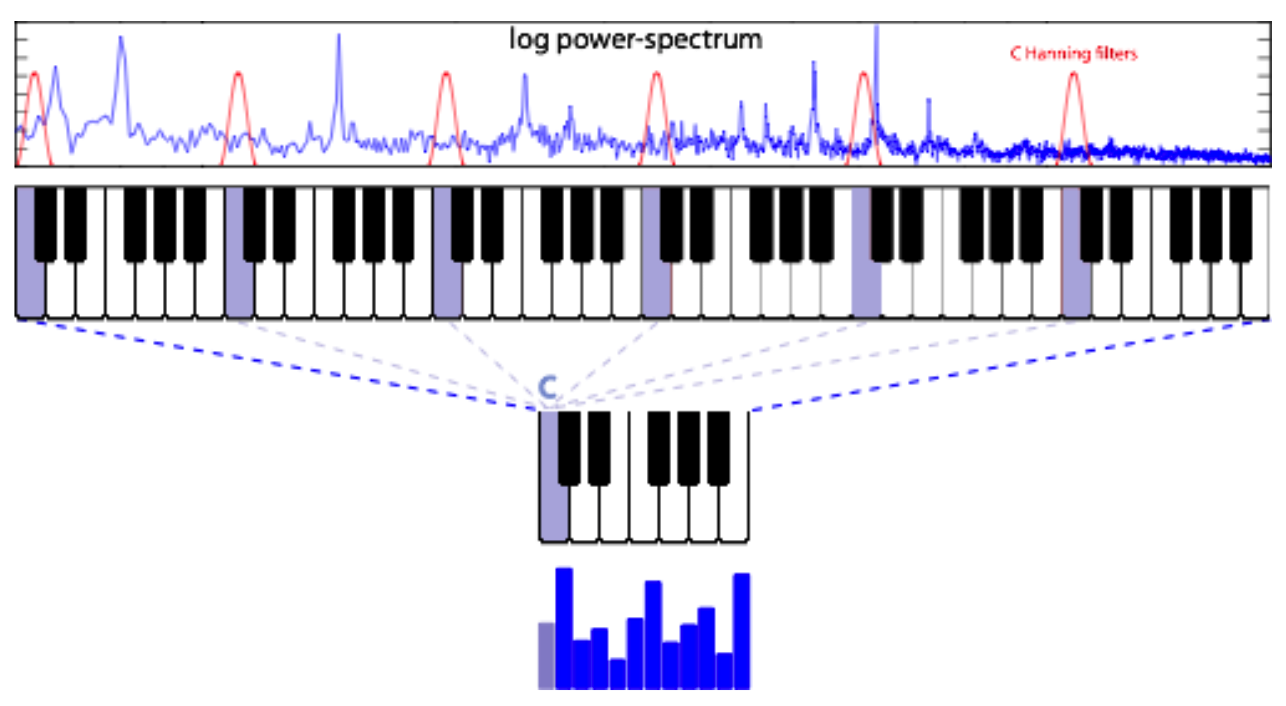 Image source: Spotify
Timbre is the quality of a musical note or sound that distinguishes different types of musical instruments, or voices. It is a complex notion also referred to as sound color, texture, or tone quality, and is derived from the shape of a segment's spectro-temporal surface, independently of pitch and loudness. The timbre feature is a vector that includes 12 unbounded values roughly centered around 0. Those values are high level abstractions of the spectral surface, ordered by degree of importance.
For completeness however, the first dimension represents the average loudness of the segment; second emphasizes brightness; third is more closely correlated to the flatness of a sound; fourth to sounds with a stronger attack; etc. See an image below representing the 12 basis functions (i.e. template segments).
 Image source: Spotify
The actual timbre of the segment is best described as a linear combination of these 12 basis functions weighted by the coefficient values: timbre = \(c1 \times b1 + c2 \times b2 + \ldots + c12 \times b12\), where \(c1\) to \(c12\) represent the 12 coefficients and \(b1\) to \(b12\) the 12 basis functions as displayed below. Timbre vectors are best used in comparison with each other.
Audio analysis tatum. A tatum represents the lowest regular pulse train that a listener intuitively infers from the timing of perceived musical events (segments).